For the curious, the cautious, and anyone who feels the call to understand this ancient life-force more deeply.
Perhaps you have heard the word Kundalini in a yoga class, during breathwork, from a spiritual teacher, or somewhere in the endless scroll of social media.
Maybe you have watched someone shaking or moving spontaneously during a Kundalini Activation and wondered what was happening.
You may already practice Kundalini Yoga, meditation, pranayama, or another energetic discipline and want to understand what connects these different approaches.
Or perhaps Kundalini entered your awareness because something unusual began happening within your own body or consciousness and you went looking for language to understand it.
Kundalini is a vast subject. It belongs to spiritual traditions much older than the modern activation practices we see today, and there are different teachings about what Kundalini is, how it awakens, and what happens when it does.
I don’t believe we need to flatten that mystery into one definitive explanation.
My intention with this guide is to give you a grounded place to begin. We will explore some of the traditional understanding of Kundalini, the different ways people work with this energy today, what people describe when Kundalini begins to move, and some of the distinctions I wish I had understood when I first entered this work.
Bring your curiosity. Bring your discernment. And perhaps most importantly, remain in conversation with your own body and inner knowing as you explore.

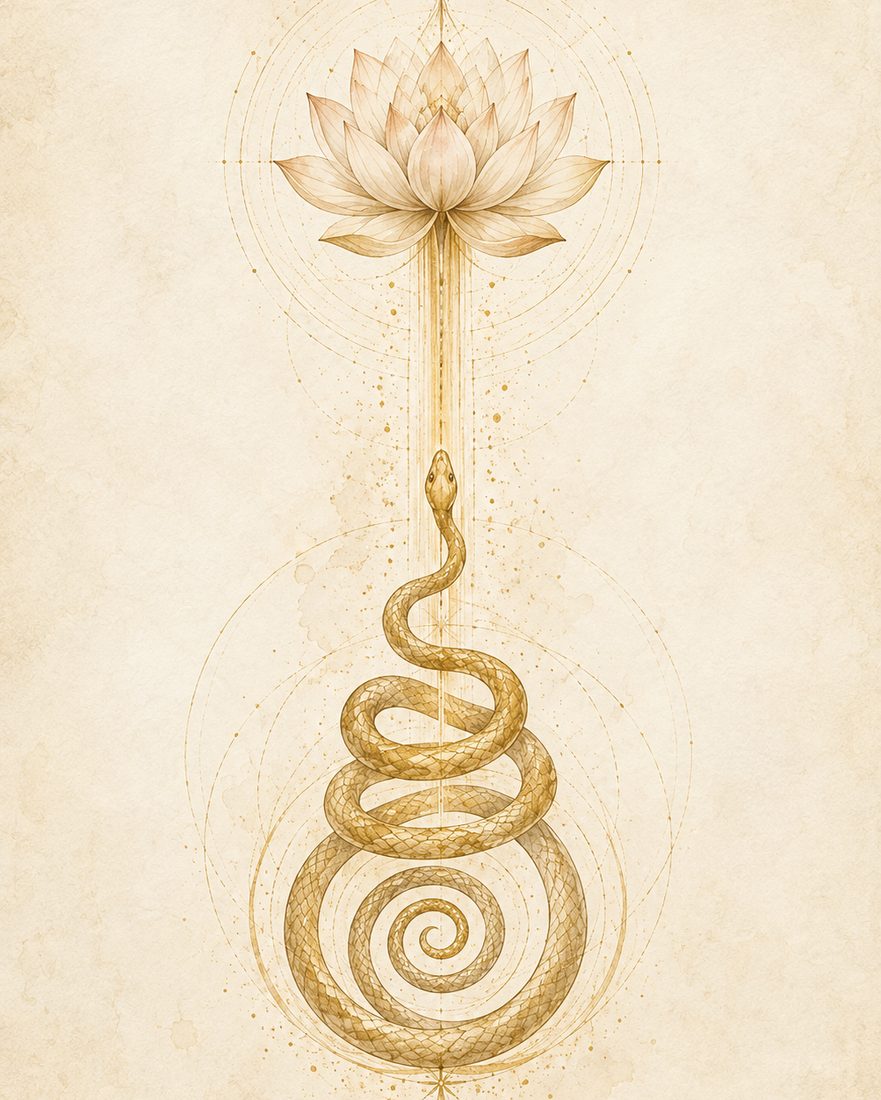
The word Kundalini comes from Sanskrit and is commonly associated with the idea of something coiled.
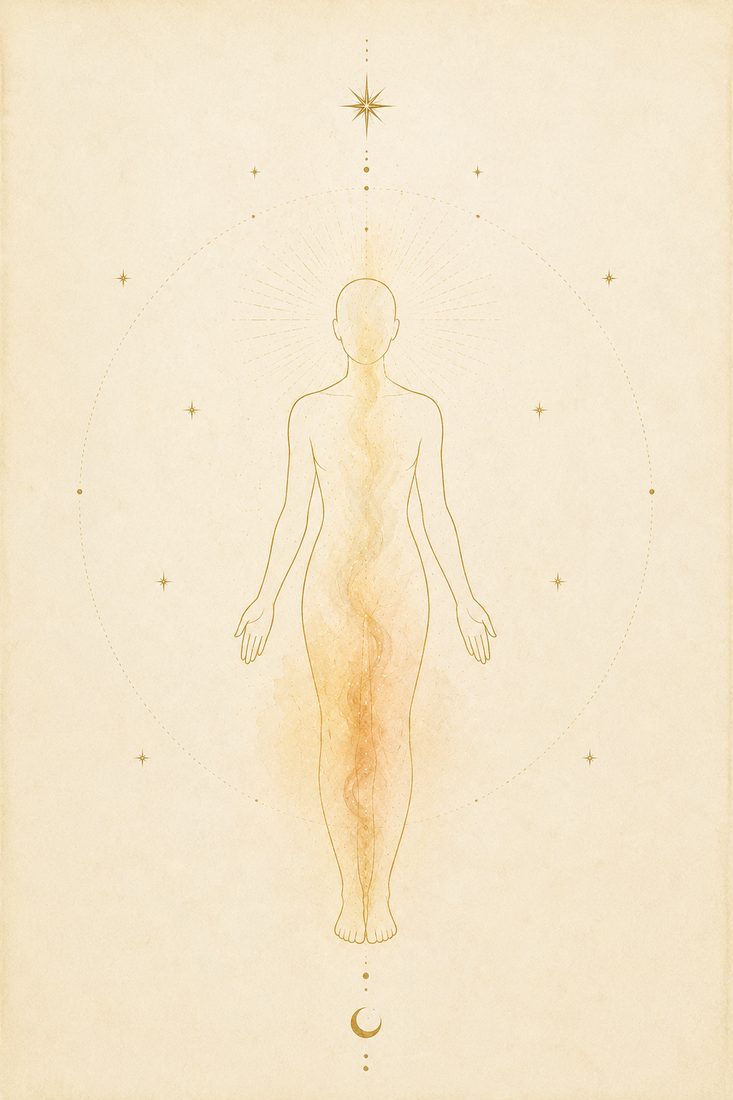
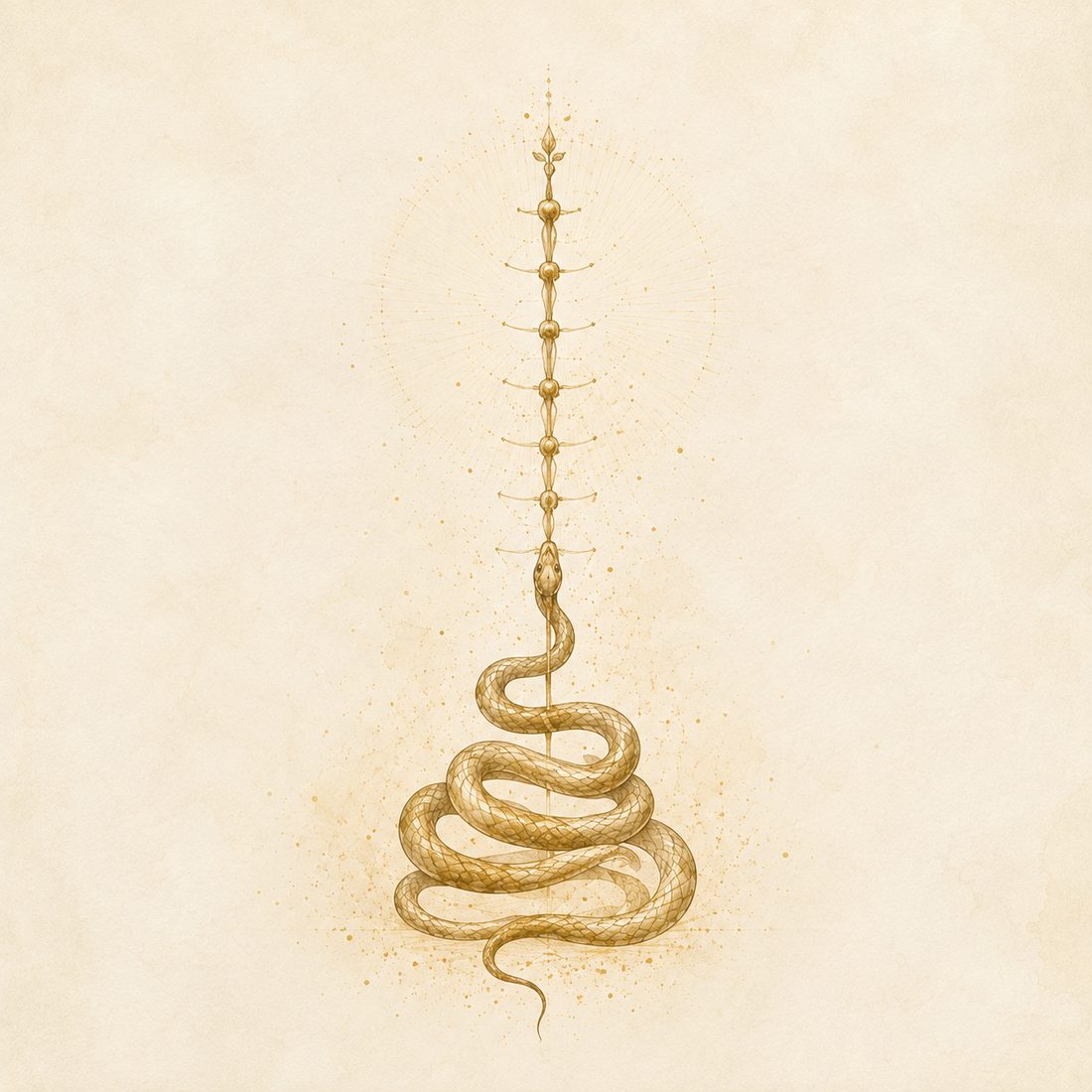
Across particular Tantric and later yogic traditions, Kundalini came to describe a latent spiritual power within the human being. It is often represented symbolically as a serpent resting in a coiled state near the base of the spine.
When awakened, traditional teachings describe this energy rising through the subtle body toward higher states of consciousness.
You will sometimes hear Kundalini described simply as “life-force energy.” I use that language throughout this guide because it is accessible, while recognizing that traditional understandings of Kundalini Shakti are considerably richer than that phrase alone can hold.
The serpent, the chakras, the central channel and the movement of Shakti belong to a subtle-body spiritual framework. They should not be confused with structures that can be physically located and measured in the body in the same way we can identify a nerve, muscle, organ, or blood vessel.
For thousands of practitioners, however, this framework has offered a language for experiences that can feel very real within the body and consciousness.
People describe:
Modern research has begun documenting some of these reported experiences, but we are still a long way from having a scientific explanation for Kundalini itself.
I actually find something beautiful in that.
We can remain curious without pretending the mystery has been solved.

To understand Kundalini, it helps to understand Shakti.
Within several Hindu and Tantric philosophical traditions, Shakti represents divine creative power. She is the dynamic principle of existence, the force through which life moves, creates and transforms.
Kundalini is often understood as a particular expression of this Shakti within the human being.
Because Shakti is personified as Goddess in many traditions, Kundalini is often spoken of through feminine language. That is richer than simply assigning the energy a gender: Shakti points toward the dynamic, creative power through which existence manifests and moves.
The serpent became one of its enduring symbols because a coiled serpent holds the image of potential. There is stillness, but within that stillness there is tremendous capacity for movement.
As Kundalini rises within traditional subtle-body maps, it is described as moving through a central channel called sushumna, passing through energetic centers that many of us now know as the chakras.
Different texts and lineages describe this process differently, which is important to remember. The modern seven-chakra rainbow system most of us encounter today is not a single unchanged map handed down intact from ancient India. Subtle-body systems developed across traditions and periods, with different numbers of chakras, symbols, practices and interpretations.
The history is far richer than the simplified version most of us first encounter.
And yet the central image remains powerful.
Something dormant begins to move.

Long before contemporary Kundalini Activation sessions existed, practitioners were cultivating spiritual energy through disciplined yogic and contemplative practice.
There isn’t one method.
Traditional and modern approaches can include combinations of meditation, mantra, devotional practice, physical postures, pranayama, mudras, bandhas, visualization and other techniques.
You may already recognize some of these.
The term Kundalini Yoga can refer broadly to yogic practices concerned with awakening Kundalini, although many Western students know it primarily through the modern system popularized by Yogi Bhajan beginning in the late twentieth century.
That modern system has its own twentieth-century history and should not be confused with the full range of older yogic and Tantric practices concerned with Kundalini.
Modern Kundalini Yoga classes often combine physical sequences or kriyas, breath practices, mantra, meditation and sometimes sustained postures.
It is an active practice. The practitioner participates intentionally through breath, movement, attention and repetition.
Pranayama refers broadly to yogic practices involving the regulation of breath and vital energy.
Some techniques are gentle and balancing. Others involve strong breathing patterns or breath retention and can create pronounced physiological and subjective effects.
Within certain traditional systems, pranayama is one component of a much larger path that includes preparation, ethics, meditation and guidance rather than simply being an isolated technique for producing an altered state.
Bandhas are often translated as energetic “locks.”
They involve particular muscular engagements, often around the pelvic floor, abdomen or throat, and may be combined with breath retention and other practices.
Within some yogic systems, bandhas are used as part of practices intended to influence the movement of prana through the subtle body.
Kundalini experiences are not limited to vigorous physical practices.
Deep meditation, contemplative practice, prayer and mantra have all been associated with reports of unusual energetic or awakening experiences.
Some people practice for years before describing anything they would identify as Kundalini.
Others never do.
This is one of the aspects of Kundalini I find most fascinating.
Not everyone who reports an awakening was trying to create one.
Researchers studying spontaneous spiritual and Kundalini-type experiences have collected accounts arising during meditation and spiritual practice, but also around intense psychological periods, encounters with nature, sexual experiences, fasting, sleep disruption and psychedelic experiences. Some people cannot identify an obvious trigger at all.
That does not prove that each of these experiences has the same underlying cause.
It does show us how varied the human experience of what people call awakening can be.
People who identify their experience as Kundalini sometimes report strong physical sensations, including heat, tingling, vibrations, involuntary movements or sensations of energy moving through the body. Others describe changes in perception, intense emotion, unusual imagery, expanded states of awareness, or a sense of unity and connection.
Some experiences are beautiful. Some are confusing. Some contain both.
This is one reason I am cautious about romanticizing Kundalini awakening.
An awakening is not necessarily a two-hour bliss experience followed by a completely transformed life. For some people, profound spiritual experiences require considerable integration afterward.

These words are often used interchangeably online, and I think separating them can bring much-needed clarity.
There is no universal authority establishing exact definitions for these terms, so I use them as practical distinctions rather than absolute spiritual laws.
I am careful with this language because I do not believe every tremor, vision, emotional release or energetic sensation should automatically be called an awakening.
Kundalini deserves more reverence than that.

One of the easiest ways to understand the modern Kundalini landscape is to notice the difference between actively cultivating an experience and receptively entering one.
Practices such as yoga, kriya, pranayama, mantra and certain meditation techniques ask the practitioner to participate intentionally. You breathe in a particular way. Hold a posture. Engage a bandha. Repeat a mantra. Direct attention.
These practices can be profound and have long histories within particular traditions.
Contemporary transmission-based Kundalini Activation practices take another approach.
The participant generally lies down, closes their eyes and receives rather than performing a prescribed sequence of techniques. Music, the facilitator’s presence and whatever energetic framework belongs to that particular modality become part of the container.
This is the path I currently facilitate. For me, it is a practice of surrender.
I don’t see these approaches as competitors.
Someone may have a beautiful Kundalini Yoga practice and also feel curious about receptive activation. Another person may prefer meditation. Someone else may feel most connected through prayer, movement, devotion or simply spending time in silence.
Different doors can lead us into relationship with ourselves.
What matters to me is understanding which door you are entering and approaching it consciously.

This may be the question I hear most often.
The most accurate answer is: it varies enormously.
Research examining Kundalini-related experiences in meditators has documented sensory, motor and emotional experiences, including vibrations, tingling, temperature changes, spontaneous movements and shifts in mood. Research into spontaneous awakening experiences has also documented reports of rising sensations, unusual energy flows and changes in awareness.
But those studies do not give us a checklist for what your experience should be.
One of the most important things I have learned through facilitating this work is that visible intensity tells us very little about the depth or meaning of someone’s experience.
The person moving dramatically beside you is not necessarily “more activated.”
And there is no prize for having the biggest experience in the room.
Stillness is not failure.

Kundalini is increasingly described online using the language of the nervous system.
This is an area where I believe discernment matters.
We know that breathing practices, meditation, music, attention, emotion, movement and interpersonal environments can affect physiological and psychological states.
There is no established science behind any of the following claims:
Those interpretations may belong to someone’s therapeutic or spiritual framework, but they should not be presented as established neuroscience.
Research can study what people report and what happens physiologically during certain practices without establishing that Kundalini itself has been scientifically identified as a biological mechanism.
My own background as an Occupational Therapist has made me deeply interested in the relationship between body, environment, regulation and experience.
It has also taught me to respect the limits of what I know.
I can hold an energetic understanding of Kundalini while also acknowledging that the human nervous system, psychology, expectation, environment, music, attention and meaning may all contribute to what someone experiences.
For me, those perspectives do not have to cancel one another out.

This question deserves more than a dramatic yes or no.
Yoga and meditation are practiced safely by many people, but neither is completely free of adverse experiences. Research on meditation has documented challenging effects for some practitioners, including anxiety, dysregulated arousal and dissociation. Yoga can also produce adverse effects, particularly when practices are performed intensely or without appropriate instruction.
Kundalini literature contains its own long history of caution around preparation, pacing and guidance.
This doesn’t mean you should fear Kundalini.
It does mean that spiritual practices deserve respect.
Take care around anyone who encourages you to:
A spiritual framework can be meaningful while medical and psychological care remain necessary.
If an experience becomes frightening, persistent, physically painful, significantly disrupts sleep or daily functioning, or involves symptoms that concern you, reach out to an appropriate healthcare professional.
If you have a history of mania, psychosis, seizures, significant dissociation, or another condition that could be affected by intense contemplative or altered-state practices, speak with an appropriate healthcare professional and disclose relevant concerns to a facilitator before participating.
You do not lose your discernment when you enter spiritual practice. You need it even more.

If Kundalini first found you through social media, you may have seen bodies shaking, arching, crying, laughing, screaming, moving into spontaneous yoga-like positions, or appearing to enter deeply altered states.
Those experiences may be completely genuine for the person having them.
They are also visually compelling, which means they are more likely to become the videos we see.
Quiet experiences rarely go viral.
This can unintentionally create the impression that Kundalini is supposed to look dramatic.
It isn’t.
Research into contemplative and Kundalini-related experiences shows considerable variation in sensory, motor and emotional phenomena. There is no evidence that the person with the largest physical response has achieved a higher level of spiritual development.
I think this distinction matters enormously.
When we begin performing spirituality for ourselves or comparing our bodies to someone else’s experience, we stop listening to what is actually happening within us.
Let the videos be someone else’s experience. You are here to discover your own.

The spiritual world contains extraordinary wisdom.
It also contains certainty where certainty may not belong.
You may encounter teachers who can explain exactly why your left hand moved, which chakra opened, what lifetime you cleared, why your body shook, or what stage of awakening you have reached.
Perhaps some of those interpretations will resonate deeply with you.
You are still allowed to question them.
A facilitator can offer a framework. A tradition can offer a map. A spiritual experience can feel profoundly meaningful.
None of those require you to surrender your discernment.
You do not owe anyone your agreement.

I facilitate Kundalini Activation because I have experienced something profound in this work.
I have felt the mystery of life-force moving through the body. I have witnessed people experience movement, emotion, silence, beauty and moments that are difficult to explain with ordinary language.
I honor those experiences without pretending I can prove exactly what caused them.
My work lives at the meeting place between the mystical and the grounded.
My years as an Occupational Therapist taught me to respect the body, individual differences, environment, function and human complexity. My spiritual path taught me that not everything meaningful can be neatly measured or explained.
Radiant Flo holds both.
I believe there is room for ancient wisdom, lived experience, modern inquiry and mystery at the same table.
When I facilitate Kundalini Activation, I am not promising to awaken your Kundalini.
I am creating a space in which you can become receptive, explore your own life-force, and discover what the experience means for you.
That distinction matters deeply to me.
Bring your curiosity.
Bring your discernment.
Stay in conversation with your own knowing.
A Gentle Introduction
You are hereThe Surrender Practice
Read Part TwoBefore Your Activation
Coming soonAfter the Experience
Coming soonLiving in Relationship With Kundalini
Coming soon
Reading about Kundalini gives us language. Being in the room gives us experience.
The experience itself is simple. You lie down. Music plays. You are invited to soften, listen inward, and allow whatever sensations, emotions, movement, or stillness naturally arise. You do not have to do anything or know anything in advance. I am with you the whole time.
Nothing needs to be forced. You do not need to see colors, feel energy move, or have a dramatic experience. Every person’s response is unique. The invitation is simply to arrive exactly as you are, listen to your system, and allow your experience to unfold in its own rhythm.
Experience Kundalini ActivationExplore upcoming ceremonies, online activations, and in-person experiences with Radiant Flo.
Kundalini is a spiritual and contemplative framework rather than a medical or diagnostic system. The experiences described throughout this guide are offered as language for personal reflection, not as a way to assess or diagnose physical or mental-health conditions.
Kundalini Activation is a complementary spiritual wellness practice and is not a substitute for medical, psychological, or psychiatric care. If something you are experiencing concerns you, please speak with an appropriate healthcare professional.